Key Milestones for AI-Enabled SaMDs

Updated: Dec 23, 2025

By Shannon Campbell, PhD, Principal Consultant, Frank Healthcare Advisors
November 28, 2025
Artificial intelligence (AI) is transforming diagnostics, imaging analysis, and clinical decision-making across the healthcare ecosystem. However, translating promising algorithms into regulated, clinically adopted Software as a Medical Device (SaMD) is a complex, multidisciplinary challenge. Success requires far more than algorithmic performance: it demands systematic alignment of regulatory expectations, evidence generation, product design, health-economic value, and reimbursement strategy.
This journey is not a sequence of disconnected compliance tasks, but as a coherent lifecycle strategy. Each milestone, from defining the Intended Use to demonstrating clinical value and navigating coverage policy, shapes a device’s trajectory toward adoption. This guide summarizes twelve essential milestones, from defining Intended Use to Post-Market Surveillance, to help innovators and teams steer their AI-enabled SaMDs from technical concept to real-world impact.
1. Establishing the Intended Use: The Foundation of the Regulatory Strategy
The Intended Use and Indications for Use represent the foundational statements upon which all regulatory, clinical, and commercial strategies rely. For AI-enabled devices, precision in defining clinical purpose, target population, user type, and workflow context is especially important. Even subtle differences in wording can materially affect the regulatory pathway. For example, describing a device as “quantifying an imaging feature” positions it within a measurement framework, whereas describing it as “diagnosing or classifying disease” places it within a higher-risk decision-making context with potentially different evidentiary expectations.
In addition, the emerging CPT Appendix S taxonomy, which categorizes AI tools as assistive, augmentative, or autonomous, has implications for both regulatory oversight and reimbursement. Thus, the Intended Use must not only convey what the algorithm technically performs, but the specific clinical contribution it makes and the anticipated level of autonomy.
Take-away Tip: Establish a disciplined and well-supported Intended Use early in development to anchor the product’s regulatory plausibility and clinical relevance.
2. Selecting the Appropriate Regulatory Pathway
Once the Intended Use is fully articulated, the next milestone involves determining the most appropriate regulatory pathway. For AI-enabled SaMDs, this analysis requires careful interpretation of precedent, risk, and the novelty of the intended clinical function.
Devices that demonstrate substantial equivalence to an existing legally marketed product may qualify for 510(k) clearance; however, this requires demonstrating that the new device’s technological characteristics do not raise new questions of safety or effectiveness. Given the rapid evolution of AI technologies, establishing a suitable predicate can be challenging.
If no valid predicate exists, the De Novo process enables novel low- to moderate-risk devices to obtain authorization. High-risk claims may require PMA, and Breakthrough Device Designation offers opportunities for streamlined FDA engagement.
Take-away Tip: Strategically choose the regulatory path early to establish clear clinical evidence requirements, timelines, and market expectations.
3. Building a High-Quality Dataset and Evidence Base
AI-enabled SaMDs depend fundamentally on the quality and representativeness of their underlying data. Regulators increasingly require developers to demonstrate that datasets are diverse, unbiased, and representative of intended-use populations and conditions.
Robust annotation, reliable reference standards, bias mitigation, and Good Machine Learning Practice (GMLP) are essential to establishing credibility.
Take-away Tip: Ensure datasets are diverse and representative of the target population; implement bias mitigation protocols for regulatory transparency.
4. Documenting Algorithm Development and Ensuring Model Control
Regulators must understand how the model was built and how it behaves. Developers must document training pipelines, preprocessing, architecture, parameters, and version control. Model-locking is essential before validation.
When updates are expected, a Predetermined Change Control Plan (PCCP) specifies allowable changes, V&V steps, and monitoring procedures.
Take-away Tip: Implement a robust model-locking process; establish a PCCP for any anticipated post-market updates.
5. Design Verification
Design verification confirms that the system meets its defined requirements and complies with IEC 62304. For AI SaMDs, verification includes correct preprocessing, safety features, cybersecurity controls, SPDF alignment, and SBOM documentation.
Take-away Tip: Leverage a traceability matrix to link verification results to requirements; document and verify SPDF and SBOM compliance.
6. Conducting Analytical Validation
Analytical validation evaluates technical performance across accuracy, precision, robustness, and repeatability. Independent datasets are essential to ensure generalizability and prevent inflated results.
Take-away Tip: Adhere to GMLP by always using independent datasets to ensure reliable, unbiased results.
7. Designing and Executing Clinical Validation Studies
Clinical validation evaluates safety and effectiveness in workflow-specific conditions. Depending on Intended Use, studies may include standalone performance evaluations, MRMC studies, prospective trials, or real-world evidence.
Take-away Tip: Define endpoints and statistical plans up front to ensure rigor and demonstrate meaningful clinical benefit.
8. Ensuring Usability and Workflow Integration
Human factors engineering evaluates how clinicians interact with the system, understand outputs, and avoid automation bias. Interface design and training materials are essential to supporting proper use.
Take-away Tip: Validate human factors engineering to manage automation bias and support safe interpretation of outputs.
9. Labeling, Risk Management, and Transparent Communication
Labeling must clearly describe Intended Use, limitations, input requirements, and known risks. ISO 14971-aligned risk management should incorporate AI-specific failure modes such as bias, drift, and cybersecurity vulnerabilities.
Take-away Tip: Ensure labeling clearly describes AI-specific failure modes and avoids overstating capabilities.
10. Aligning with Reimbursement Pathways
Clinical adoption depends on reimbursement. Many AI-enabled services require Category III codes initially, progressing to Category I. CPT Appendix S provides structure for categorizing AI contributions. Payer engagement and clinical utility evidence are essential.
Take-away Tip: Integrate CPT and payer requirements early to avoid adoption barriers after FDA authorization.
11. Implementing Post-market Surveillance
AI systems require continuous monitoring for drift and real-world performance changes. PMS programs are expected by regulators and essential when operating under a PCCP.
Take-away Tip: Continuously monitor for drift and degradation to support long-term regulatory trust.
12. Engaging Effectively with Regulators
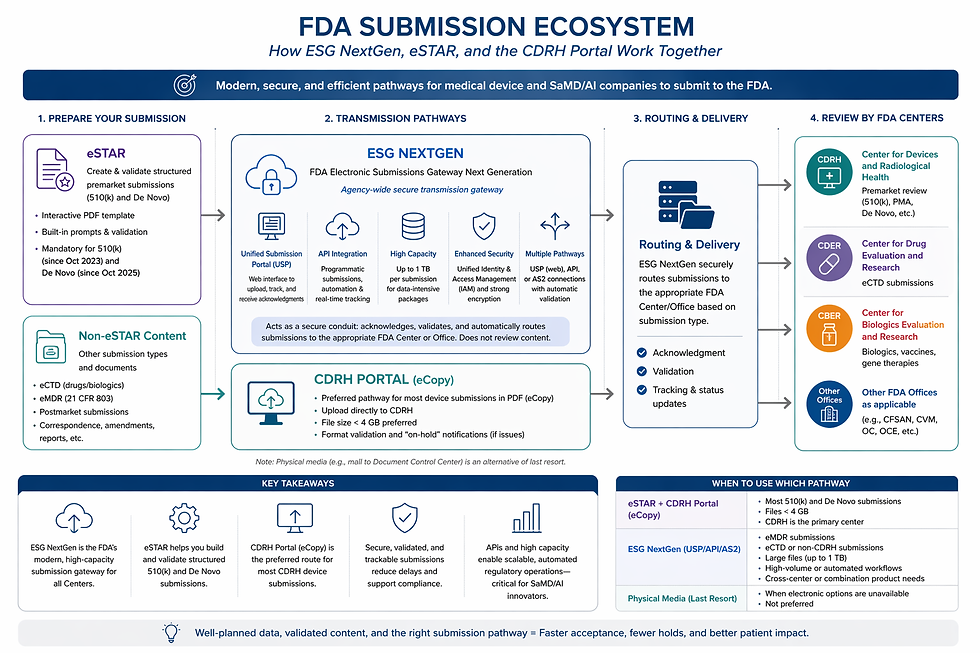
Proactive FDA engagement through the Pre-Submission (Q-Sub) process helps align on validation, PCCP structure, and predicate strategy.
Take-away Tip: Use Q-Sub pathways early to resolve complex evidentiary questions and streamline review.
A Coordinated Pathway from Innovation to Impact
Success in AI-enabled SaMD development demands early, coordinated alignment of regulatory strategy, evidence generation, product design, user needs, and reimbursement. Following these milestones helps ensure that technical innovation becomes trusted, real-world clinical impact.


Comments